

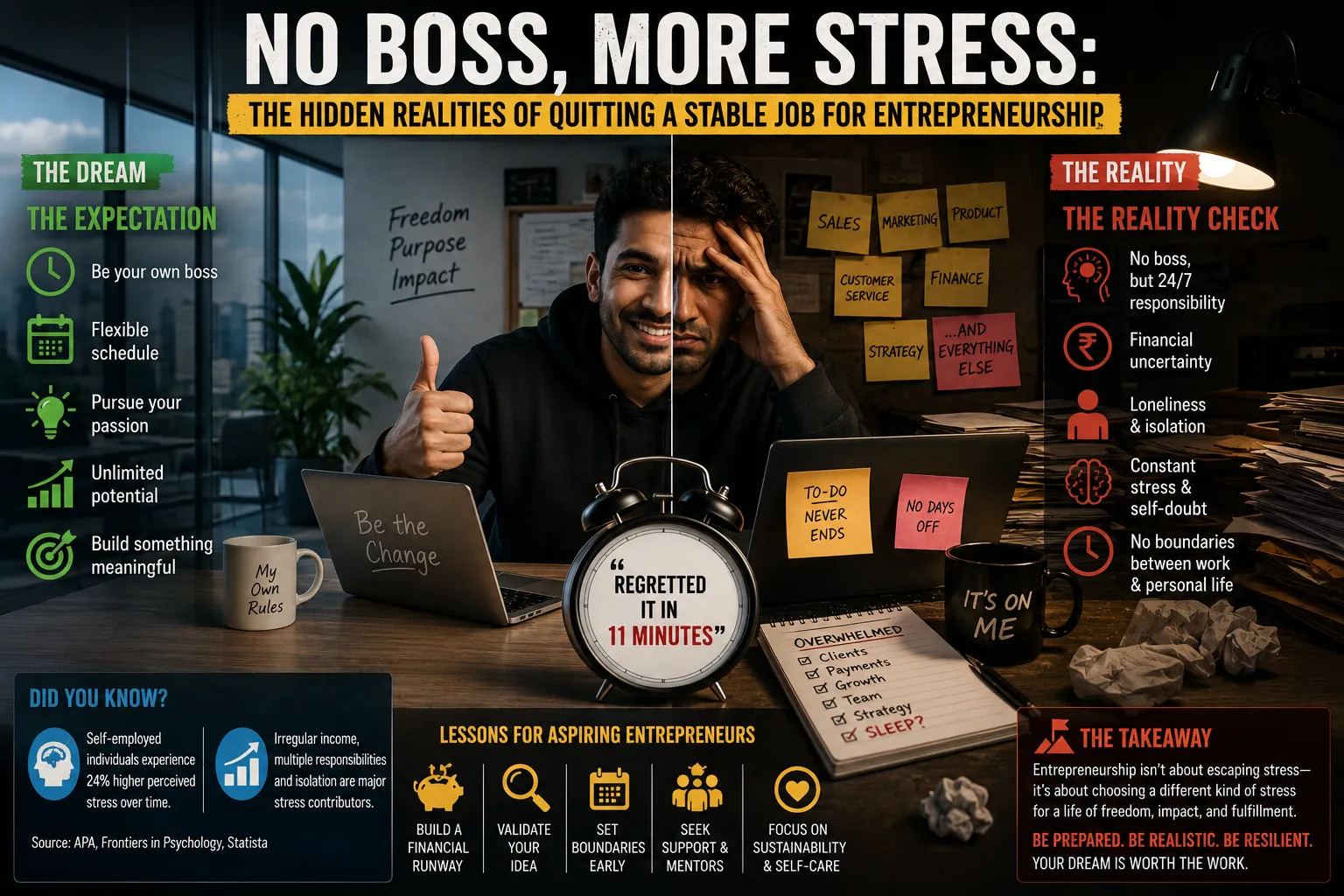
The allure of entrepreneurship often paints a picture of ultimate freedom—no micromanaging boss, flexible hours, and the chance to build something meaningful on your own terms. For many professionals trapped in unfulfilling corporate roles, leaving a steady paycheck seems like the pathway to personal and financial liberation. Yet, as one entrepreneur’s candid admission reveals, the dream can rapidly transform into a landscape of relentless pressure, financial uncertainty, and self-doubt. “No boss, more stress” has become an increasingly common refrain among those who have made the leap.
Entrepreneur and digital creator Mehul Agrawal recently shared a relatable and honest reflection in a viral video. After quitting his job in pursuit of freedom to build his venture, he humorously noted that he “regretted it in 11 minutes.” What began as excitement quickly gave way to anxiety as the weight of unlimited responsibility settled in. His story resonates deeply because it strips away the glamour often associated with startup life and exposes the emotional and practical challenges many face but few discuss openly.
The Initial High and the Sudden Crash
On his first day after resigning, Agrawal woke up energized and spent hours meticulously planning the next three months of his business. The second day involved refining those plans with even greater enthusiasm. By the third day, however, anxiety crept in. Without the structure of a corporate environment—clear deadlines, team support, and predictable income—the founder found himself solely accountable for every decision, from strategy to execution.
This pattern is far from unique. Many who transition from employment to self-employment describe a similar trajectory: an initial burst of motivation followed by the stark realization that freedom comes with its own demanding master—the business itself. Suddenly, every hour not spent working feels like lost progress. There are no boundaries between personal time and professional demands. The absence of a boss does not mean the absence of oversight; instead, the entrepreneur becomes the harshest critic and the only one responsible for outcomes.
Research and surveys consistently show that self-employed individuals often report higher stress levels than traditional employees. One study indicated that those transitioning to self-employment experience around 24% higher perceived stress over time, with elevated cortisol levels reflecting the constant mental load. Factors such as irregular income, the need to wear multiple hats, and isolation contribute significantly to this burden.
Why Entrepreneurship Feels Heavier Than Expected
In a traditional job, roles are defined. You contribute to a larger machine, often with support systems, shared accountability, and benefits like health insurance or paid leave. Entrepreneurship dissolves these guardrails. Founders handle sales, marketing, product development, customer service, finance, and strategy—frequently alone in the early stages. This “everything falls on me” reality creates decision fatigue and emotional exhaustion.
Agrawal highlighted this irony: while employees romanticize the founder’s life as one of autonomy, the reality involves greater workload because success or failure rests entirely on individual shoulders. Many entrepreneurs describe feeling more overworked than in their previous corporate positions, with the added psychological pressure of knowing that stopping work directly impacts revenue.
Financial instability amplifies the stress. Unlike a salaried position with predictable deposits, business income can fluctuate wildly. Months of investment with little return are common, testing savings, resilience, and relationships. This uncertainty often leads to self-doubt, imposter syndrome, and even burnout—issues that studies link more intensely to entrepreneurial paths due to the personal liability involved in every choice.
Loneliness emerges as another unexpected challenge. Corporate environments provide social interaction, mentorship, and camaraderie. Solo entrepreneurship can feel isolating, with founders making tough calls without immediate feedback or collaborative brainstorming. Building in public, as Agrawal does through social media, helps some combat this by fostering community, but it also exposes vulnerabilities to public scrutiny.
The Mental Health Dimension
The glorification of hustle culture on social platforms often masks these struggles. Aspiring entrepreneurs see highlight reels of success while the daily grind, sleepless nights, and moments of questioning one’s choices remain hidden. This disconnect contributes to mental health challenges within the entrepreneurial community.
Experts note that while entrepreneurship offers high autonomy and potential for personal fulfillment—factors that can boost long-term satisfaction—it simultaneously demands exceptional emotional regulation. Entrepreneurs frequently score higher on both stress and optimism scales, creating a paradox where the work is demanding yet deeply rewarding for those who persist.
Agrawal’s decision to share both highs and lows reflects a positive shift. More founders are normalizing conversations around mental health, failures, and the non-linear nature of building a business. His venture, focused on creating value through innovation, stems from leaving a draining corporate environment—suggesting that while the path is tough, the motivation often comes from seeking greater purpose.
Lessons for Aspiring Entrepreneurs
Stories like Agrawal’s serve as crucial reality checks rather than deterrents. They underscore the importance of preparation before quitting. Key recommendations from those with experience include:
-
Build a runway: Save enough to cover 12–18 months of expenses to reduce immediate financial panic.
-
Validate ideas: Test business concepts while still employed, if possible, to gather early traction.
-
Set boundaries: Establish routines that prevent work from consuming all personal time.
-
Seek support: Join founder communities, hire help when feasible, or find mentors to share the load.
-
Focus on sustainability: Prioritize systems, delegation, and self-care from the outset to avoid early burnout.
Not every entrepreneur regrets the leap. Many ultimately find the autonomy and impact worth the initial struggles. However, success often requires resilience, adaptability, and realistic expectations. Entrepreneurship is less about escaping stress and more about choosing a different, often more intense, form of it in exchange for potential freedom and fulfillment.
Balancing Dream and Reality
The narrative of “quit your job and live your passion” sells courses and inspires dreams but rarely prepares people for the grind. True entrepreneurial success stories usually involve years of unseen effort, pivots, and persistence through doubt. For every viral founder celebrating exits, countless others navigate quiet periods of uncertainty.
Agrawal’s reflection does not discourage entrepreneurship but invites a more nuanced view. He continues building his company despite the early anxiety, driven by a desire to create something meaningful. His transparency encourages aspiring business owners to enter the arena with eyes wide open—celebrating the freedom while preparing for the responsibility it entails.
In today’s dynamic economy, where job security evolves and remote opportunities expand, the decision to pursue entrepreneurship demands careful self-assessment. Weigh personal risk tolerance, financial preparedness, and emotional readiness. The path without a boss offers immense potential but requires inner strength to manage the amplified pressures that come with it.
Ultimately, entrepreneurship is not a universal solution to workplace dissatisfaction. For some, it transforms life positively; for others, the stress outweighs the rewards. Honest conversations, like the one sparked by Agrawal, help individuals make informed choices—whether that means pursuing a venture, improving their current role, or finding hybrid paths such as side hustles. The key lies in aligning ambitions with practical realities rather than idealized visions.
As more professionals reconsider their careers post-pandemic, stories highlighting both the challenges and rewards of going solo become invaluable. They remind us that while there may be no boss, the work of building a business demands leadership of the highest order—starting with oneself.
pressnbcnews pressnbcnews pressnbcnews pressnbcnews pressnbcnews pressnbcnews pressnbcnews pressnbcnews pressnbcnews pressnbcnews pressnbcnews pressnbcnews pressnbcnews pressnbcnews pressnbcnews pressnbcnews pressnbcnews pressnbcnews pressnbcnews pressnbcnews pressnbcnews pressnbcnews pressnbcnews pressnbcnews pressnbcnews pressnbcnews pressnbcnews pressnbcnews pressnbcnews pressnbcnews pressnbcnews pressnbcnews pressnbcnews pressnbcnews pressnbcnews pressnbcnews pressnbcnews pressnbcnews pressnbcnews pressnbcnews pressnbcnews pressnbcnews pressnbcnews pressnbcnews pressnbcnews pressnbcnews pressnbcnews pressnbcnews pressnbcnews pressnbcnews pressnbcnews pressnbcnews pressnbcnews pressnbcnews pressnbcnews pressnbcnews pressnbcnews pressnbcnews pressnbcnews pressnbcnews pressnbcnews pressnbcnews pressnbcnews pressnbcnews pressnbcnews pressnbcnews pressnbcnews pressnbcnews pressnbcnews pressnbcnews pressnbcnews pressnbcnews pressnbcnews pressnbcnews pressnbcnews pressnbcnews pressnbcnews pressnbcnews pressnbcnews pressnbcnews pressnbcnews pressnbcnews pressnbcnews pressnbcnews pressnbcnews pressnbcnews pressnbcnews pressnbcnews pressnbcnews pressnbcnews pressnbcnews pressnbcnews pressnbcnews pressnbcnews pressnbcnews pressnbcnews pressnbcnews pressnbcnews pressnbcnews pressnbcnews pressnbcnews pressnbcnews pressnbcnews pressnbcnews pressnbcnews pressnbcnews pressnbcnews pressnbcnews pressnbcnews pressnbcnews pressnbcnews pressnbcnews pressnbcnews pressnbcnews pressnbcnews pressnbcnews pressnbcnews pressnbcnews pressnbcnews pressnbcnews pressnbcnews pressnbcnews pressnbcnews pressnbcnews pressnbcnews pressnbcnews pressnbcnews pressnbcnews pressnbcnews pressnbcnews pressnbcnews pressnbcnews pressnbcnews pressnbcnews pressnbcnews pressnbcnews pressnbcnews pressnbcnews pressnbcnews pressnbcnews pressnbcnews pressnbcnews pressnbcnews pressnbcnews pressnbcnews pressnbcnews pressnbcnews pressnbcnews pressnbcnews pressnbcnews pressnbcnews pressnbcnews pressnbcnews pressnbcnews pressnbcnews pressnbcnews pressnbcnews pressnbcnews pressnbcnews pressnbcnews pressnbcnews pressnbcnews pressnbcnews pressnbcnews pressnbcnews pressnbcnews pressnbcnews